7 Common Casting Defects and How to Prevent Them
Learn the 7 most common casting defects, what causes each one, and the exact fixes that stop porosity, shrinkage, cold shuts and more before they hit scrap.
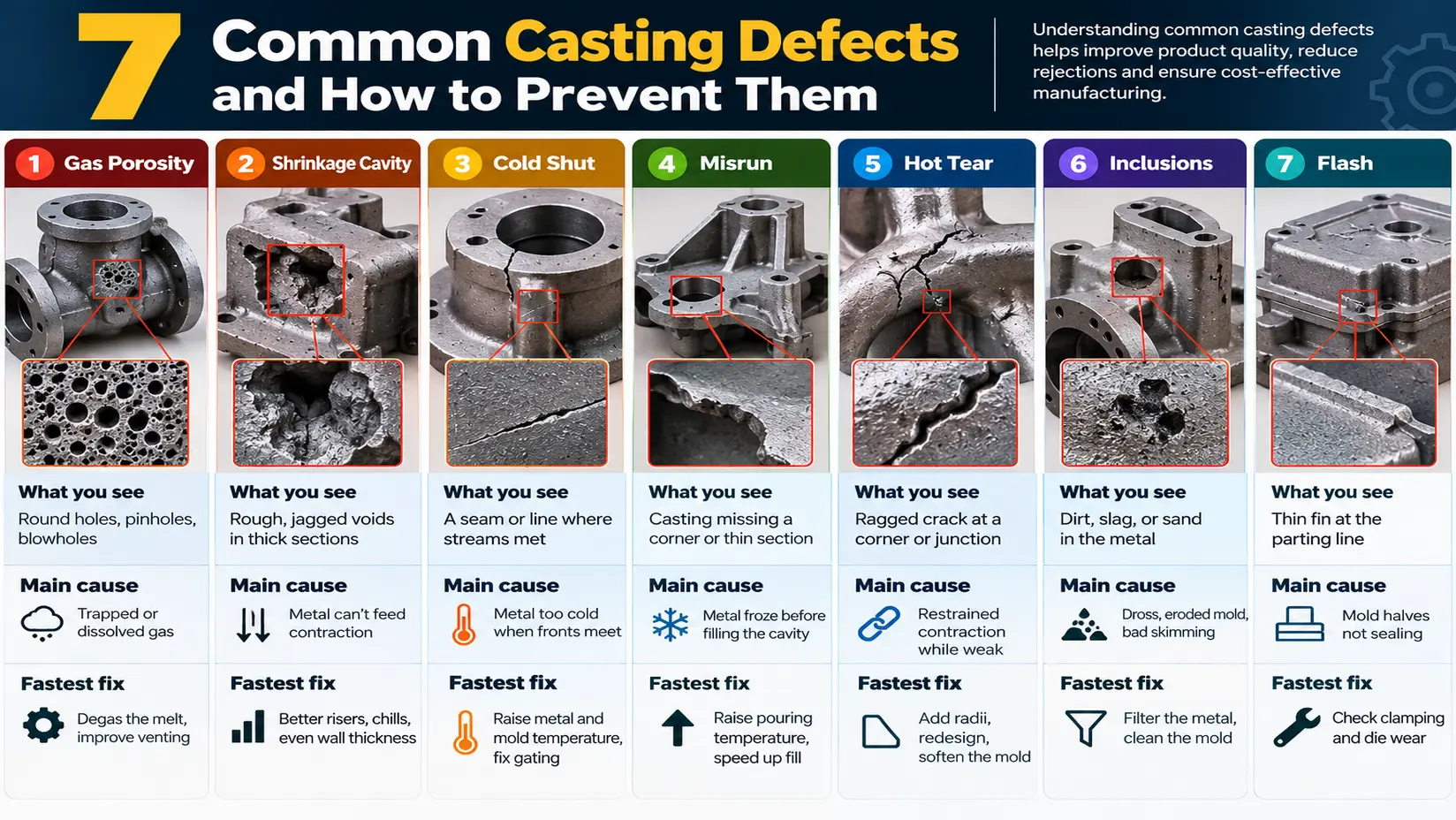
Casting defects are flaws that form while molten metal fills a mold, solidifies, or cools. The seven you'll meet most often are gas porosity, shrinkage cavities, cold shuts, misruns, hot tears, inclusions, and flash. Almost every one traces back to the same three things: gas, heat flow, and metal flow.
That's the short version. The rest of this guide shows how to recognize each defect, why it forms, and what to change on the shop floor or in the design to stop it.
Casting Defects at a Glance
| Defect | What you see | Main cause | Fastest fix |
|---|---|---|---|
| Gas porosity | Round holes, pinholes, blowholes | Trapped or dissolved gas | Degas the melt, improve venting |
| Shrinkage cavity | Rough, jagged voids in thick sections | Metal can't feed contraction | Better risers, chills, even wall thickness |
| Cold shut | A seam or line where streams met | Metal too cold when fronts meet | Raise metal and mold temperature, fix gating |
| Misrun | Casting missing a corner or thin section | Metal froze before filling the cavity | Raise pouring temperature, speed up fill |
| Hot tear | Ragged crack at a corner or junction | Restrained contraction while weak | Add radii, redesign, soften the mold |
| Inclusions | Dirt, slag, or sand in the metal | Dross, eroded mold, bad skimming | Filter the metal, clean the mold |
| Flash | Thin fin at the parting line | Mold halves not sealing | Check clamping and die wear |
1. Gas Porosity
Gas porosity shows up as smooth, round holes. Sometimes they're pinholes just under the skin. Sometimes they're big blowholes that break the surface. The usual trap: a casting looks perfect until a machinist cuts into it and opens a cavity right where the bolt hole goes.
Why it happens. Liquid metal holds gas that solid metal can't. Aluminum is the classic case. Molten aluminum dissolves roughly 20 times more hydrogen than it can keep once it freezes, so the extra gas comes out of solution and forms bubbles. Moisture in the mold, damp scrap, oily charge material, and turbulent pouring all feed the problem. In sand casting, a mold packed too hard or vented too little leaves the gas nowhere to go.
How to prevent it:
- Preheat and dry charge material, tools, and ladles. Moisture is hydrogen waiting to happen.
- Degas aluminum melts with a rotary degasser and inert gas (argon or nitrogen) before pouring.
- Keep sand moisture and binder gas generation within spec, and vent molds and cores properly.
- Cut turbulence in the gating system. Air that gets dragged into the stream becomes porosity.
- Check permeability if you're running green sand. A dense mold traps gas.
2. Shrinkage Cavities
Metal contracts as it goes from liquid to solid. If nothing feeds that lost volume, you get a void. External shrinkage looks like a sunken dimple on the surface. Internal shrinkage hides inside, usually in the heaviest section, with a rough, dendritic, almost feathery inner surface. That texture is how you tell it apart from gas porosity, which is smooth.
Why it happens. The thickest part of a casting freezes last. If the riser freezes before that section does, the riser can't feed it and the void forms. Sudden changes in wall thickness create hot spots that cool slowly and starve. Pouring too hot makes things worse because there's more liquid contraction to make up.
How to prevent it:
- Size risers so they freeze after the casting section they feed. A riser that solidifies first is useless.
- Place chills (metal inserts that pull heat out fast) against hot spots to force directional solidification toward the riser.
- Keep wall thickness as uniform as the part allows. When it can't be uniform, blend thick and thin areas gradually rather than stepping.
- Lower the pouring temperature within the range your alloy allows.
- Run solidification simulation before cutting tooling. It's cheaper than reworking a pattern.
3. Cold Shuts
A cold shut is a seam. Two streams of metal meet inside the mold, and instead of fusing into one solid mass they just touch, leaving a crease or line that can look like a crack. It's a real weak point. Parts with cold shuts can pass a visual check and still fail under load.
Why it happens. The metal front cools too much on its way across the cavity. By the time the two fronts meet, their surfaces have oxide skins or have already started to freeze, so they won't weld together. Low pouring temperature, a cold mold or die, slow filling, and long flow paths are the usual suspects. In die casting, low injection speed is a frequent culprit.
How to prevent it:
- Raise metal temperature and, in die casting, die temperature, to the alloy's recommended window.
- Fill faster, but without causing turbulence. That's the balance you're tuning.
- Rework gating so metal reaches the far end of the cavity from more than one direction, and so streams meet in hot metal, not cooling metal.
- Make sure thin sections aren't thinner than the alloy and process can reliably fill.
- Keep vents clear so trapped air doesn't resist the incoming metal.
4. Misruns
A misrun is a casting that didn't finish. A corner is rounded off, a thin rib is missing, or an edge stops short. Cold shuts and misruns get lumped together because the cause overlaps, but they're different failures: a misrun leaves the cavity unfilled, while a cold shut fills it with a bad joint.
Why it happens. The metal froze before it got to the end. The reasons are familiar: pouring temperature too low, poor fluidity in the alloy, a slow or interrupted pour, thin sections too far from the gate, or a mold that pulled heat out too aggressively.
How to prevent it:
- Raise the pouring temperature and preheat the mold, especially permanent molds and dies.
- Pour in one continuous stream. Stopping and restarting a pour is a guaranteed misrun on thin parts.
- Choose an alloy with better castability if the geometry demands it.
- Add gates or enlarge the runner so metal arrives at thin features hot.
- Redesign extremely thin walls. If it needs a wall the process can't fill, the part is the problem, not the pour.
5. Hot Tears
A hot tear (also called hot cracking) is a ragged, irregular crack that forms while the casting is still cooling, typically at an inside corner, a thick-to-thin junction, or a spot where the mold or core holds the metal in place.
Why it happens. Metal is weak when it's almost solid but not quite. If the casting tries to contract and something stops it, such as a rigid sand core or a sharp corner concentrating stress, the part pulls itself apart at its weakest point. Alloys with a wide freezing range, like some aluminum and steel grades, tear more easily. Uneven cooling makes it worse.
How to prevent it:
- Add generous radii at corners and junctions. Sharp internal corners are stress magnets.
- Make cores and molds collapsible so they give as the metal shrinks.
- Even out section thickness and use chills or fillets to balance cooling.
- Lower pouring temperature a little and avoid extreme thermal gradients.
- Adjust alloy chemistry or grain refinement if a particular grade keeps tearing.
One catch worth knowing: some fixes for one defect cause another. A hotter pour helps a misrun but can invite shrinkage and tearing. Change one variable at a time and write down what happened.
6. Inclusions (Slag, Dross, and Sand)
Inclusions are foreign material trapped in the casting. It might be slag or dross from the melt, oxide films folded into the metal, or sand grains knocked loose from the mold. They show up as dark spots or rough patches on machined surfaces, and they cut the strength of the part.
Why it happens. Dirty melt, poor skimming, turbulent pouring that folds surface oxide into the stream, and mold or core surfaces that erode under the flow of hot metal. If you can find sand grains in the casting, your mold is washing away.
How to prevent it:
- Skim the melt carefully before every pour and keep the ladle clean.
- Put ceramic foam filters in the gating system. They catch particles and also calm the flow.
- Design a gating system that fills the mold smoothly. For aluminum, keeping metal velocity at the gate below about 0.5 m/s reduces oxide entrainment.
- Strengthen the mold: raise binder content, compact the sand properly, and use a good mold wash or coating.
- Use a pouring basin or sprue design that traps slag before it enters the cavity.
7. Flash
Flash is a thin sheet or fin of excess metal along the parting line or around cores and inserts. It's mostly a die casting and permanent mold problem. It won't usually cause a part to fail structurally, but it costs money in trimming and can wreck dimensional tolerances on mating faces.
Why it happens. The mold or die halves don't seal tightly. Worn die surfaces, insufficient clamping force, too much injection pressure, debris on the parting line, and misaligned halves all let metal squeeze out.
How to prevent it:
- Match clamping force to the projected area and injection pressure. Too little force lets the die breathe.
- Clean the parting line every cycle and inspect the die for wear and damage.
- Don't over-pressurize. If you're cranking injection pressure to fix another defect, flash is the price.
- Check die alignment, tie bar balance, and core fit.
- Schedule die maintenance on shot count, not when flash is already in the bin.
How to Catch Casting Defects Before They Ship
Prevention is the goal, but detection decides how much a defect costs you. Surface flaws like cold shuts, misruns, and flash are easy to spot visually. Internal ones aren't. Gas porosity and shrinkage cavities can sit invisible until machining.
Common inspection methods:
- Visual and dimensional checks for surface defects and misruns.
- Dye penetrant testing for surface-breaking cracks and cold shuts.
- Radiographic (X-ray) inspection for internal porosity and shrinkage.
- CT scanning for complex parts where you need a full 3D picture of internal voids.
- Ultrasonic testing for thick sections and subsurface flaws.
Pick the method by the failure you're worried about. A bracket that carries a pressure load deserves X-ray. A decorative housing probably doesn't.
Design Choices That Prevent Defects
A surprising share of casting defects start on the drawing board, not at the furnace. A few design habits remove entire categories of trouble:
- Keep wall thickness uniform, and transition gradually where it must change.
- Round every inside corner you can.
- Avoid isolated heavy sections that can't be fed by a riser.
- Add draft so the part releases cleanly.
- Talk to your foundry before you finalize the model. Ten minutes with a foundry engineer can save a tooling revision.
Frequently Asked Questions About Casting Defects
What is the most common casting defect?
Porosity, in both its gas and shrinkage forms, is the most common casting defect. It's also the hardest to diagnose because it often sits inside the part and only shows up during machining, leak testing, or X-ray inspection.
What causes porosity in casting?
Porosity comes from two sources. Gas porosity is caused by dissolved or trapped gas, usually hydrogen or air, that can't escape as the metal freezes. Shrinkage porosity comes from metal contracting on solidification without enough liquid metal to feed the gap.
What is the difference between a cold shut and a misrun?
A misrun is an incomplete casting where the metal froze before filling the mold. A cold shut is a fully formed casting with a weak seam where two metal streams met but didn't fuse. Both come from metal that's too cold or too slow, but the result looks and fails differently.
How do you prevent casting defects?
Control the three drivers: gas, heat, and flow. Degas the melt, dry the mold and charge, design uniform sections with generous radii, size risers and gates properly, hold pouring temperature in the right window, and inspect with the right method for each defect.
Can casting defects be repaired?
Some can. Minor porosity and surface defects are sometimes fixed by welding, impregnation, or machining. Cracks, cold shuts, and large internal voids in structural parts usually mean scrap. Check the customer's specification before repairing anything.
Stop Fixing Defects and Start Designing Them Out
Every defect above has a physical cause you can measure: temperature, moisture, flow speed, section thickness, mold condition. Pick the defect costing you the most scrap, find its cause in the table at the top, and change one variable at a time.
If you're sourcing castings rather than making them, send your foundry the drawing early and ask where they'd expect trouble. The good ones will tell you.
Ready to Transform Your Manufacturing?
Discover how our advanced steel casting technology can revolutionize your manufacturing process.
Contact Us Today