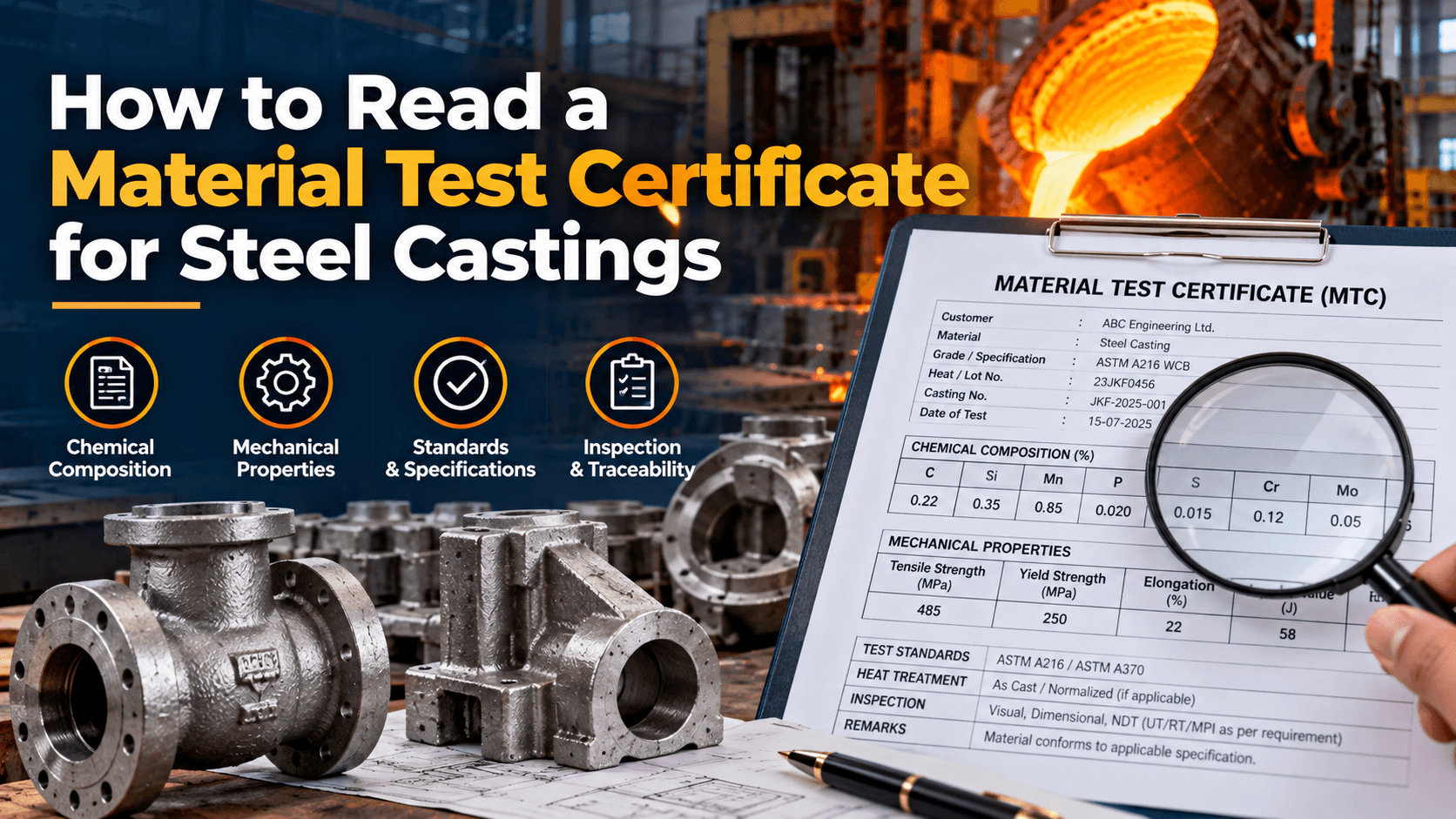
How to Read a Material Test Certificate for Steel Castings
A batch of castings lands at your dock with a material test certificate stapled to the delivery note — and most buyers glance at it, see a stamp, and sign off. This guide breaks down exactly what to check on that certificate, field by field, and the specific red flags that separate a genuine batch record from paperwork that won’t hold up if a part fails later.
How to Choose the Best Steel Casting Manufacturer in India for Your Industrial Requirement
Most RFQs for steel castings get sent to five foundries at once, and the deciding factor ends up being whichever quote came back cheapest. Then the batch arrives, the tolerances are off, or the material test certificate doesn't match what was agreed, and the "savings" disappear into rework, delay, and a second round of sourcing.
Price matters. It just shouldn't be the first filter. The order that actually protects you is: capability, then material expertise, then quality control, then price — because a cheap casting that fails inspection costs more than an expensive one that doesn't.
What to Check First
Before you contact anyone, get your own technical package together: drawing or CAD model, material or steel grade, component weight, quantity, and any machining, heat-treatment, or inspection requirements. A foundry can only quote accurately against what you give them — a vague "need steel castings, 500 units" email gets you a vague quote back, and vague quotes are where misunderstandings start.
1. Technical Capability Matching Your Component
Not every foundry that casts steel casts your steel. A shop set up for small, simple shapes in short runs isn't the right fit for a 400kg structural bracket, and vice versa.
Ask directly: has this foundry cast something close to your geometry and weight range before? Can their engineering team flag a casting problem — a section that's prone to porosity, a wall thickness that won't fill properly — before they pour metal, not after you reject the batch? That second question tells you more than a client list does, because anyone can list clients. Fewer foundries can tell you, unprompted, what's going to go wrong with your drawing.
2. Material Expertise, Not Just Material Availability
A supplier saying "yes, we do steel castings" is not the same as a supplier who controls chemical composition tightly enough that batch 12 matches batch 1. We work primarily in low carbon steel grades, cast iron (CI) grades, grade 1030, and ISO-standard grades — and even within that range, the right choice depends on what the part actually does in service, not what sounds impressive on a spec sheet.
If your component takes repeated impact, elongation matters as much as tensile strength. If it's a bearing housing running hot, you care about different numbers entirely. A foundry that asks you what the part does before recommending a grade is doing it right. One that just quotes against the grade number you supplied, without a single clarifying question, may just be filling an order rather than engineering a solution.
3. Quality Control Through the Whole Process, Not Just at the End
Final inspection catches problems. It doesn't prevent them. The foundries worth working with control quality at every stage — incoming raw material, pattern and mould preparation, melt chemistry, pouring, heat treatment, and machining — so that a defect gets caught in-process, not after the part is fully finished and the cost of rework has gone up at every step along the way.
Ask how they document and correct a quality issue when one comes up. Not "do you have a quality system" — everyone says yes to that. Ask for the actual mechanism: who catches it, what happens next, how it's recorded.
4. Inspection and Testing Matched to Your Component
Different parts need different checks, and knowing which ones apply to yours is part of what you're paying a competent supplier for:
- Visual inspection — surface defects, general condition
- Dimensional inspection — critical dimensions against your approved drawing
- Chemical analysis — composition verified against spec, not just "in range" of a broader standard
- Mechanical testing — tensile strength, yield strength, elongation, hardness
- Non-destructive testing (NDT) — surface and internal discontinuities, without damaging the part, where specified
Agree on the inspection plan before production starts, not after the batch is cast. A supplier who wants to lock this down upfront is one who's confident in their own process. One who's vague about it until you ask twice is telling you something too.
5. Custom Manufacturing, Not Just Catalog Parts
Most industrial buyers aren't ordering an off-the-shelf part — they're ordering to a drawing, a sample, or a reverse-engineered reference from a part that's already failed in the field. That's a different capability than running a catalog SKU. A foundry handling OEM replacement components, heavy engineering equipment, or low-volume specialized parts needs to translate your drawing into a casting process, not just match a part number.
6. Heat Treatment That's Actually Documented
Heat treatment is where a lot of a casting's real mechanical performance gets locked in — annealing, normalizing, quenching, tempering, depending on the grade and the application. Ask whether the process you need is something they run in-house and can document with a report, or something they outsource. Neither answer disqualifies a supplier automatically. But an answer you can't get a straight response to probably should.
7. Machining — In-House or Through a Partner
If your part needs machining after casting — tight tolerances, bores, assembly interfaces — find out whether that happens under the same roof or gets handed off to a third party. Both can work. What matters is that you know which one you're getting, because it changes your lead time and your point of accountability if something comes back out of spec.
8. Certifications, Checked Against Practice
A certificate tells you a management system exists. It doesn't tell you the system is actually followed on the floor. When you're evaluating certifications, look past the logo: check the current scope of certification, ask about traceability procedures, and ask how they've handled a customer complaint in the past. A foundry that can describe a real complaint and how it was resolved is more credible than one that just says "we've never had an issue" — because every foundry has had an issue at some point, and the ones worth trusting are the ones honest about it.
9. Production Capacity and Realistic Lead Times
Discuss your required annual quantity, batch size, and expected lead time up front — including inspection and machining time, not just casting time, because that's where quoted lead times often quietly fall apart. A supplier who gives you a lead time that sounds too good against your quantity probably hasn't accounted for the full process. Ask them to walk you through it stage by stage.
10. Communication That Surfaces Problems Early
This gets skipped in most supplier evaluations and it shouldn't. A foundry that tells you about a potential issue during production — a dimension trending out of tolerance, a material delay — gives you time to react. One that stays quiet until delivery day doesn't. You can't fully test this before placing an order, but you can get a read on it from how they handle your RFQ: do they ask clarifying questions, or just send a number back?
11. Total Value, Not Just the Quoted Price
Quality, consistency, delivery reliability, technical support, and price — all five determine what a casting actually costs you, not just the number on the quote. A part that needs rework, a batch that arrives late and stalls your own production line, a supplier who can't explain a test result when you ask — these costs don't show up on the invoice, but they show up somewhere.
Industrial Steel Casting Manufacturer vs. General Foundry
Not every foundry specializes in the same kind of work, and a general-purpose shop isn't automatically the wrong choice — but for demanding, application-specific components, look for a track record in engineering castings, heavy-duty applications, and customer-specific specifications, not just casting in general. The closer a supplier's actual experience sits to your application, the fewer surprises you'll manage during production.
Why JK Foundry
We're based in Foundry Nagar, Agra — an industrial area built around casting, which means the local supply chain for patterns, sand, and finishing is already in place rather than something we have to coordinate across the country. We've been running since 2010, hold ISO 9001:2015, ISO 45001:2018, ISO 14001:2015, and ZED certification, and our casting unit runs an induction furnace with up to 500 kg capacity per heat across three dedicated units — casting, fettling, and a newer higher-capacity facility.
We work in green sand, shell, and CO2 moulding, casting low carbon steel grades, cast iron (CI) grades, grade 1030, and ISO-standard grades — and we'll tell you plainly if a spec inherited from a previous supplier looks over-engineered for what your part actually needs to do, rather than just quoting against whatever grade number you send us.
Frequently Asked Questions
How do I choose a steel casting manufacturer?
Evaluate technical capability, material expertise, quality systems, inspection capabilities, customization options, certifications, production capacity, and delivery reliability — in that order, before comparing final price.
What information should I provide to a steel casting manufacturer?
A component drawing or CAD model, material specification, quantity, dimensions, machining requirements, heat-treatment requirements, and inspection requirements wherever you have them. The more complete this package, the more accurate your quote.
What's the difference between carbon steel and cast iron (CI) castings?
Carbon steel offers higher tensile strength and better impact tolerance, which suits components under repeated loading or shock. Cast iron handles vibration damping well and costs less per kilogram, but it's more brittle under sudden impact. The right choice depends on what the part actually experiences in service — we'll ask about load, impact, and environment before recommending a grade, rather than defaulting to whichever one quotes cheaper.
Can industrial steel castings be manufactured to a custom drawing?
Yes — most industrial orders are exactly this, not catalog parts. What varies between foundries is how well they translate a drawing or sample into an actual casting process, which is worth testing with a small first order before committing to volume.
Why does inspection matter this much for industrial castings?
Because a part that passes a casual visual check can still fail dimensionally, chemically, or mechanically — and a load-bearing or safety-relevant component that fails in the field costs far more than the inspection would have.
How do I request a quotation from JK Foundry?
Send your drawing, required material, quantity, and any technical requirements you have. The more detail in the first message, the faster and more accurate the quote that comes back.
Choosing on More Than the Lowest Number
The right steel casting manufacturer in India is the one whose capability, material expertise, and quality process actually match what your component needs — not the one with the lowest line-item price on a quote you'll end up re-sourcing six months later. A foundry that gets this right becomes a long-term manufacturing partner instead of a one-time vendor.
Have an industrial component that needs to be cast in steel? Send JK Foundry your drawing or component requirements and we'll walk through it with you.
Ready to Transform Your Manufacturing?
Discover how our advanced steel casting technology can revolutionize your manufacturing process.
Contact Us Today