Steel Casting Manufacturing Process: From Pattern Making to Final Inspection
Steel casting involves far more than melting and pouring metal. This guide walks through each stage of the process, from pattern making and mould preparation to heat treatment, inspection and finishing, and explains how process control affects the quality of the final casting.
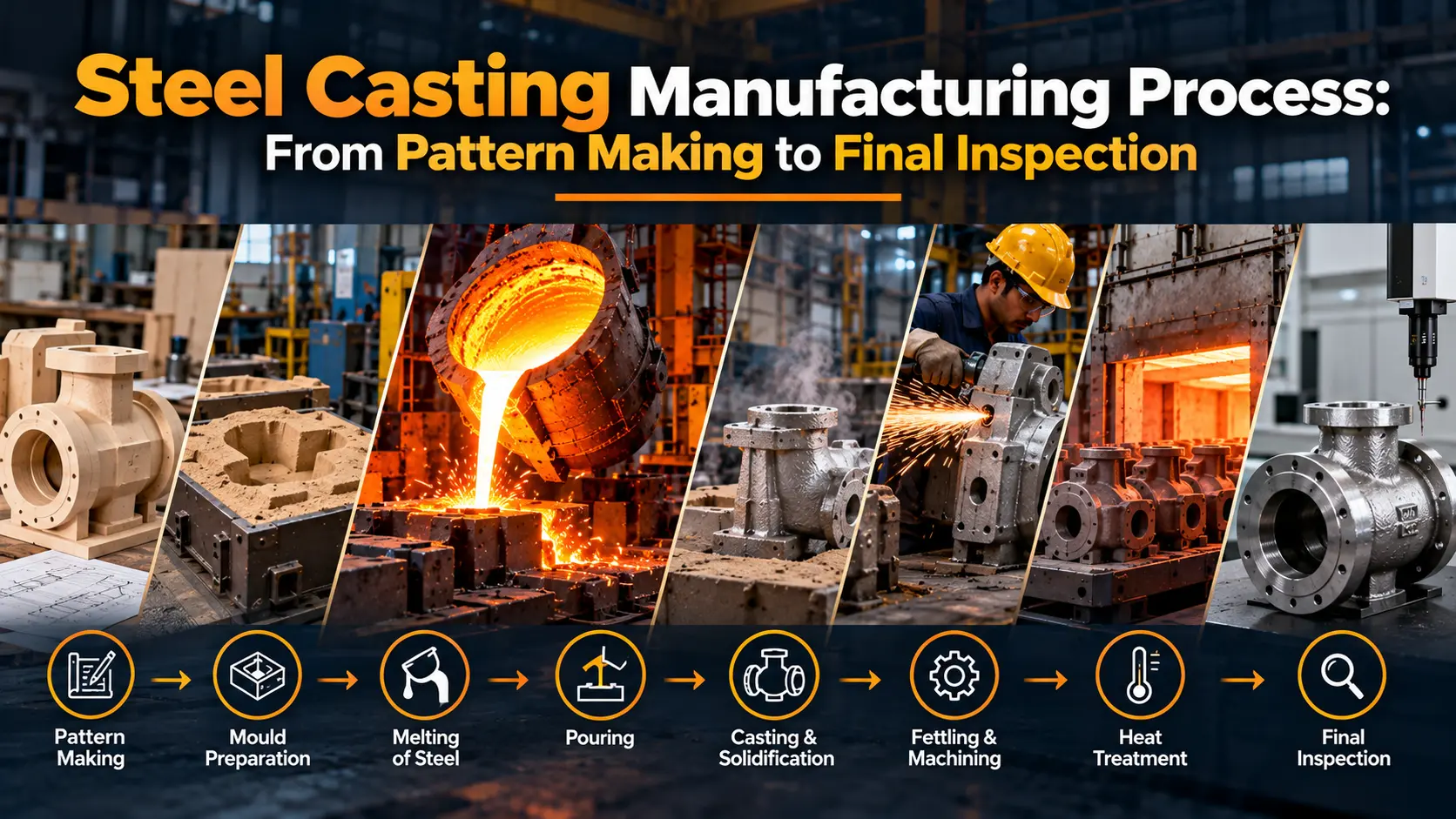
Steel Casting Manufacturing Process: From Pattern Making to Final Inspection
A casting doesn't fail at final inspection. It fails three weeks earlier, when a pattern dimension was off by half a millimeter and nobody caught it until the part was already poured, cooled, and machined. Final inspection just tells you where the mistake happened. It doesn't undo it.
That's the real argument for understanding the steel casting manufacturing process before you place an order — not as trivia, but as a way to ask better questions of whoever's casting your part.
Quick Answer
Steel casting manufacturing runs through roughly 19 connected stages: engineering review, casting design, pattern making, mould preparation, core making (where needed), melting, chemical composition verification, pouring, solidification, shakeout, fettling, heat treatment, dimensional inspection, visual inspection, non-destructive testing where specified, mechanical testing, final documentation, machining, and packing/dispatch. A problem introduced early — in pattern design or melt chemistry — carries through every later stage and usually costs more to fix the later it's caught.
What Is Steel Casting?
Steel casting is a manufacturing method where molten steel goes into a prepared mould cavity, cools, solidifies, and comes out as a part close to its final shape. It's the process of choice when a component's geometry would be difficult or expensive to produce by forging, machining from bar stock, or welding fabrication — complex internal passages, irregular wall sections, one-piece parts that would otherwise need to be welded together from several pieces.
Steel castings are produced in different grades depending on the application. At JK Foundry, our production centers on low carbon steel grades, cast iron (CI) grades, grade 1030, and ISO-standard grades — chosen based on what the part actually needs to withstand in service, not just what's cheapest to quote.
The Full Sequence, Stage by Stage
Engineering Drawing → Casting Design → Pattern Making → Mould Preparation → Core Making (where needed) → Steel Melting → Chemical Analysis → Pouring → Solidification → Shakeout → Fettling → Heat Treatment → Dimensional Inspection → Visual Inspection → NDT (where specified) → Mechanical Testing → Final Documentation → Machining → Packing and Dispatch
The exact order shifts depending on the component, grade, size, and what the customer's actually asked for. A small, simple bracket skips several of these steps entirely. A load-bearing component with tight tolerances doesn't get to skip any of them.
1. Engineering Drawing and Requirement Review
Everything starts with understanding what the part actually needs to do, not just what it needs to look like. We review the component drawing or CAD model, material grade, weight, tolerances, surface finish, heat-treatment needs, mechanical property targets, inspection requirements, quantity, and the conditions the part will actually face in service.
This is also where a casting problem gets caught before it becomes an expensive one. A section that's going to be prone to porosity, a wall thickness that won't fill properly under gravity pouring — a foundry that flags this at the drawing stage, before any pattern gets cut, saves you a redesign cycle later.
2. Casting Design and Process Planning
Once the requirement's understood, the actual casting process gets planned: parting line, pattern design, mould configuration, allowances for shrinkage and machining, gating, risering, and how the metal's expected to solidify through the part's different sections.
This stage is where most casting defects get prevented or guaranteed, long before any steel is melted. Good gating and risering design means the metal fills evenly and solidifies in a controlled sequence. Bad design here shows up later as shrinkage porosity nobody can fix without scrapping the part.
3. Pattern Making
The pattern creates the cavity the molten steel fills. It carries shrinkage allowance, machining allowance, draft angles, and parting lines built into its own dimensions, because steel contracts as it cools and the final part has to land within tolerance after that contraction happens.
A dimensional error in the pattern doesn't stay contained to the pattern. It transfers straight into the mould and then into every casting poured from it — one bad pattern, repeated across a hundred castings, is a hundred rejects waiting to happen. Foundries that maintain their patterns carefully produce more consistent batches across repeat orders for exactly this reason.
4. Mould Preparation
The mould is built around the pattern and has to hold its shape and strength against the thermal shock of molten steel being poured in — a different demand than holding shape at room temperature. Mould strength, cavity accuracy, venting (so trapped gas doesn't end up as a defect in your casting), gating, and riser placement all get set here.
5. Core Making
Where a casting needs an internal cavity or passage the outer mould can't form on its own — a hollow section, an internal channel — a core goes in to shape it. If a core shifts during pouring, you get a dimensional deviation on the inside of the part — much harder to catch than an external one, because you can't see it without cutting the casting open or running NDT.
6. Steel Melting
The specified grade gets melted under controlled conditions — charge materials, melting temperature, alloy additions, and pouring temperature all managed together, because the chemistry of the molten metal is what determines the mechanical properties of the finished casting. Get this stage wrong and no amount of careful finishing downstream fixes it.
7. Chemical Composition Verification
Before the steel gets poured, composition is checked against spec — carbon, silicon, manganese, sulphur, phosphorus, and whatever other elements the grade calls for. This is the step a lot of buyers never see, and it's also the one that decides whether the material test certificate you receive later actually means anything. (We've written more on how to read that certificate and what to check on it if you want the buyer's-side version of this same check.)
8. Pouring of Molten Steel
Pouring temperature, pouring speed, mould condition, and how the metal flows through the gating system together determine whether the mould fills cleanly or not. Pour too cold and you risk a cold shut — two streams of metal meeting without fully fusing. Pour too hot or too fast and you risk mould erosion or turbulence that traps gas in the casting. This stage happens in minutes and most of what goes wrong here doesn't show up until much later, at inspection.
9. Solidification and Cooling
Different sections of a casting cool at different rates depending on their thickness — a thick section holds heat longer than a thin one next to it, and that mismatch is exactly what riser design is supposed to manage. Get the feeding wrong here and you get shrinkage-related voids in the last sections to solidify. The casting has to cool enough before anyone touches it, which is one of the quieter reasons rushed production schedules produce more defects.
10. Shakeout
Once cooled, the casting comes out of the mould — shakeout. At this stage it's still rough: gates, risers, mould material, and surface residue all still attached. It doesn't look like the finished part yet, and it isn't meant to.
11. Fettling and Cleaning
Gates and risers get removed, surfaces get ground and cleaned, mould residue comes off. This is also where over-aggressive finishing takes a casting out of tolerance without anyone noticing until it's measured — excess material removed here doesn't come back, so this stage needs the same care as any machining operation.
12. Heat Treatment
Depending on the grade and what the part needs to do in service, heat treatment — annealing, normalizing, quenching, tempering, stress relieving — changes the metallurgical structure to hit the required mechanical properties. Not every casting needs the same cycle, and temperature, holding time, and cooling method all have to match the actual material grade, not a generic recipe.
13. Dimensional Inspection
The finished casting gets checked against the approved drawing — overall dimensions, hole locations, thickness, critical features. This confirms the part's actually usable for assembly or the next machining operation, not just that it looks roughly right.
14. Visual and Surface Inspection
Surface cracks, misruns, cold shuts, excess metal, visible porosity — a trained eye catches a lot here, though not everything. Visual inspection is necessary but it's not sufficient on its own, which is exactly why the next two stages exist.
15. Non-Destructive Testing
For castings where internal soundness matters — load-bearing components, safety-relevant parts — non-destructive testing checks what visual inspection can't see, without damaging the part:
Ultrasonic testing uses high-frequency sound waves to find certain internal discontinuities.
Magnetic particle inspection catches surface and near-surface discontinuities in ferromagnetic materials.
Radiographic testing examines internal characteristics the other two methods might miss.
Which method applies depends on the material, geometry, and how critical the part actually is — not every casting needs all three.
16. Mechanical Testing
Where the spec calls for it, mechanical tests verify tensile strength, yield strength, elongation, impact properties, and hardness against the grade's requirements. This is the data that ends up on your material test certificate, and it's worth checking it line by line against what you actually ordered rather than just confirming a certificate exists.
17. Final Inspection and Quality Documentation
Before dispatch, everything gets reviewed together — material grade, chemistry, heat treatment, dimensions, surface condition, mechanical properties, NDT results, and anything specific to your order. Good documentation here is what gives you traceability if a question comes up six months after delivery, not just a formality to clear before shipping.
18. Machining and Additional Finishing
Some castings ship as-cast or heat-treated with no further work. Others need machining for holes, threads, mounting surfaces, bearing surfaces, or tight-tolerance features. Whether machining happens, and whether it's done in-house or through a partner, needs to be settled before production starts — because machining allowance has to be built into the casting design from the start, not added as an afterthought.
19. Packing and Dispatch
Final approval, identification, quantity verification, packing, documentation, loading, shipment. It's the least technically interesting stage and also the one that determines whether everything upstream actually reaches you intact.
What Commonly Goes Wrong
Porosity — voids from trapped gas or poor solidification conditions.
Shrinkage — discontinuities from feeding that didn't keep pace with how the casting cooled.
Cold shut — two streams of metal meeting without properly fusing, usually a pouring-temperature or gating issue.
Inclusions — non-metallic material trapped in the casting during melting or pouring.
Dimensional variation — traceable back to pattern error, mould movement, or inconsistent process control.
None of these get fixed by inspecting harder at the end. They get prevented by controlling the stages where they originate — which is the whole argument for evaluating a foundry's process, not just its final inspection report.
Why the Manufacturing Process Matters When You're Choosing a Supplier
A supplier's process capability shows up in your casting as consistency, dimensional accuracy, material properties, surface quality, and — the one that actually costs money — rejection rate. Two foundries can quote the same price on paper and deliver very different outcomes depending on how tightly they control stages 1 through 12 above, long before anything reaches final inspection.
At JK Foundry, we run three dedicated units — casting, fettling, and a newer higher-capacity facility — out of Foundry Nagar, Agra, with an induction furnace running up to 500 kg per heat. We hold ISO 9001:2015, ISO 45001:2018, ISO 14001:2015, and ZED certification, and we work primarily in green sand, shell, and CO2 moulding. If you want the fuller picture of what to check before choosing any supplier, not just us, we've laid that out in how to choose a steel casting manufacturer in India.
Frequently Asked Questions
What are the main stages of the steel casting process?
Broadly: engineering review, pattern and mould preparation, melting and chemical verification, pouring, solidification, fettling, heat treatment, inspection and testing, and finally machining and dispatch. The exact sequence varies by component and grade.
What causes most steel casting defects?
Porosity, shrinkage, cold shuts, inclusions, and dimensional variation are the most common — and nearly all of them trace back to decisions made early in the process (pattern design, gating, melt chemistry) rather than anything that happens at the finishing stage.
Why does chemical composition matter so much in steel casting?
Because it determines the mechanical properties of the finished part — strength, hardness, wear resistance. A casting can look dimensionally perfect and still fail in service if the chemistry was off during melting.
Do all steel castings need heat treatment?
No. It depends on the grade and the mechanical properties the application requires. Not every casting needs the same heat-treatment cycle, and some need none at all.
How do I know if my casting needs non-destructive testing?
It depends on how critical the part is and what fails if it breaks. Load-bearing or safety-relevant components usually warrant NDT; a low-stress bracket usually doesn't. Your foundry should be able to recommend this based on the application, not just quote whatever you ask for.
Looking for a Steel Casting Manufacturer?
If you need custom steel castings for an industrial application, send us your engineering drawing, material grade, quantity, and inspection requirements and we'll evaluate it properly — not just quote against a number.
Ready to Transform Your Manufacturing?
Discover how our advanced steel casting technology can revolutionize your manufacturing process.
Contact Us Today