Green Sand, Shell, CO2 or Lost Foam: Which Moulding Process Suits Your Casting?
Compare green sand, shell, CO2 and lost foam moulding by part weight, volume, tolerance, material and tooling cost, and pick the right process for your casting.
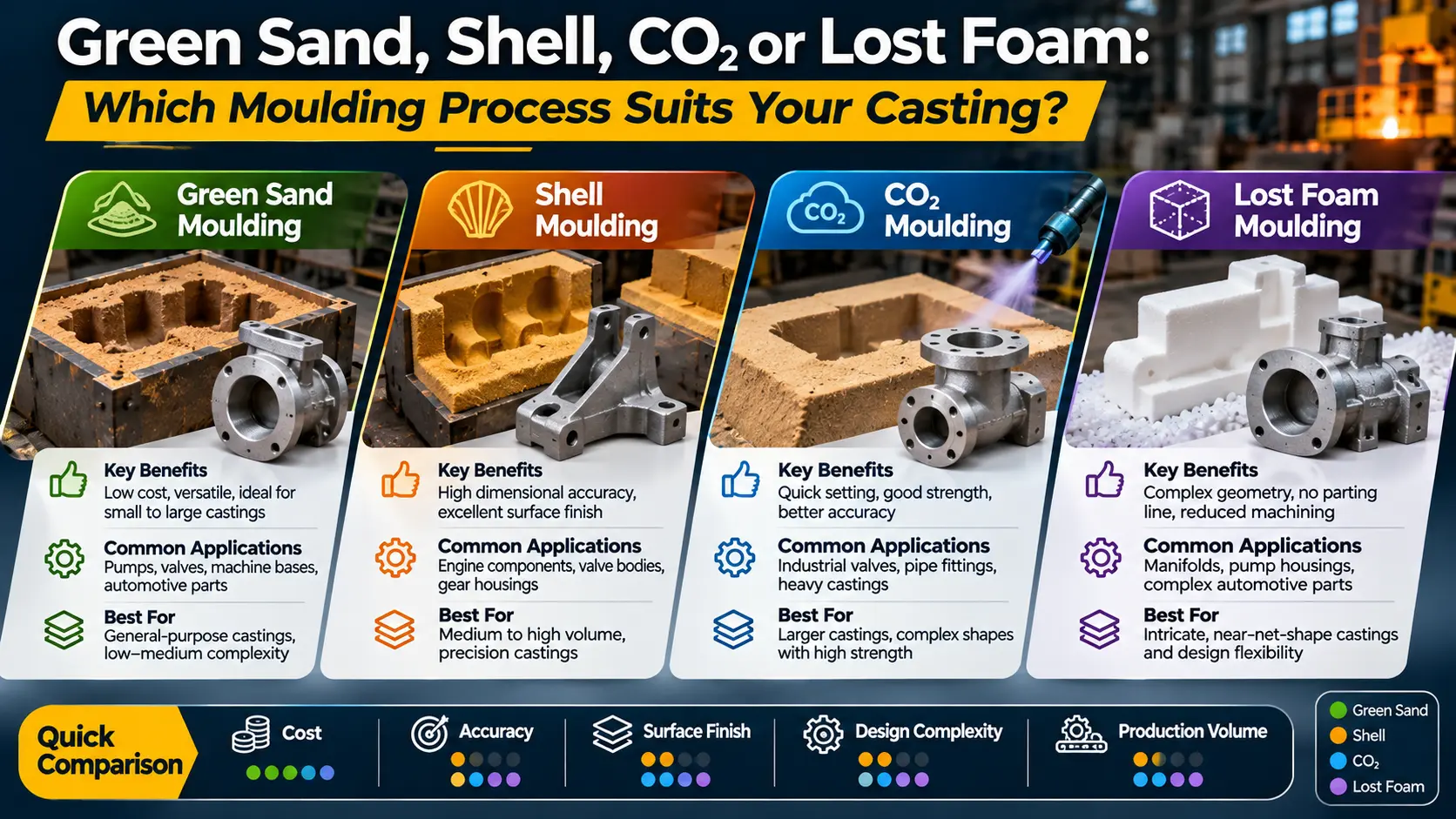
There's no single best moulding process. Green sand wins on cost and volume. Shell moulding wins on finish and tolerance for smaller parts. CO2 moulding wins on simplicity for medium and heavy steel castings, and lost foam wins on complex shapes in high-volume iron and aluminium. Your casting's weight, material, volume and tolerance decide which one is yours.
A common mistake is choosing by price per kilo on the first quote. The moulding process also sets your draft angle, machining allowance, tooling bill and defect risk. A cheap casting that arrives with 6 mm of extra stock to machine off isn't cheap by the time it leaves your machine shop.
Which Moulding Process Should You Choose?
Choose green sand for medium-to-high volume castings where cost matters more than finish. Choose shell moulding for small parts that need fine detail and tight tolerances. Choose CO2 moulding for medium to heavy steel castings in short runs. Choose lost foam for complex, high-volume iron or aluminium parts where the tooling can pay for itself.
| Factor | Green sand | Shell | CO2 (sodium silicate) | Lost foam |
|---|---|---|---|---|
| Binder | Bentonite clay and water | Resin-coated sand, heat-cured | Sodium silicate, hardened with CO2 gas | None (unbonded sand) |
| Part size | Small to very large | Small to medium (sources cite roughly 14–23 kg) | Medium to very heavy | Wide range, but foam patterns are fragile |
| Volume | Medium to high | Medium to high | Low to medium | High |
| Tolerance across the parting line | About ±1.5 mm (±0.060 in) | About ±0.75 mm (±0.030 in) | Moderate | Close, with no mould shift |
| Draft | About 2–3° | About 1° | Typical sand-mould draft | Little to none |
| Surface finish | Rougher | Smoother | Moderate | Excellent |
| Tooling cost | Low | Medium (metal pattern) | Low | High |
| Materials | Iron, steel, non-ferrous | Ferrous and non-ferrous | Mainly steel and heavy iron | Aluminium, gray and ductile iron proven; check for steel |
Treat the tolerance and weight figures as starting points. Every foundry has its own limits, and the only number that counts is the one in your quote.
Green Sand Moulding
How it works. Silica sand, bentonite clay and water are packed around a pattern while the mix is still damp. "Green" means uncured, not the colour.
Choose it when you want low tooling cost and a process that handles everything from small castings to very heavy ones. Match plates are cheap to make and cheap to change, which matters when your drawing is still moving. It's the default for medium-to-high volume work in iron and steel, and for most buyers it's where the conversation should start.
Watch out for the rougher surface, which reflects the grain size of the sand, and the looser tolerance of about ±1.5 mm across the parting line. Plan for a draft of 2–3° and a generous machining allowance. Side shift between the mould halves can also move features. And because the mould is damp, uncontrolled moisture or permeability turns into gas holes and sand inclusions. Our guide to casting defects covers both.
Shell Moulding
How it works. A heated metal pattern is coated with resin-bonded sand. The resin cures against the hot pattern and forms a hard shell about 6–10 mm (1/4 to 3/8 in) thick. Two shell halves are clamped together and poured. The sand is finer than in green sand (fineness 100+ against 60–80), so it picks up more detail.
Choose it when the part is small to medium, the detail is fine, and you're tired of paying for machining. Draft drops to about 1°, tolerance tightens to about ±0.75 mm, and the machining allowance shrinks. Here's the part buyers miss: a shell casting can quote higher per piece and still be the cheaper part overall, because it weighs less and needs less metal removed.
Watch out for the metal pattern, which is a real upfront cost, and for weight. Sources put the practical limit somewhere around 14–23 kg, so ask your foundry for its own ceiling. Flat parts can also swell, because the thin shell has little weight to hold it in place.
CO2 Moulding
How it works. Sand is mixed with sodium silicate (water glass), packed around the pattern, and CO2 gas is blown through it. The gas precipitates silica gel, and the sand hardens. No oven, no long cure. Typical binder use is about 3 to 3.5% of the sand weight.
Choose it when you're making medium to very heavy steel castings, especially in short runs, and want to avoid gas trouble. The binder has no sulphur, phosphorus or nitrogen, which is why gas defects and cracking run low. Patterns can be simple and cheap. Steel foundries use sodium silicate sand for valves and mechanical castings from 10 kg to 5,000 kg, so heavy steel is its home ground.
Watch out for three things. The first is collapsibility. Silicate-bonded sand breaks down poorly after pouring, so the mould holds the casting while it tries to contract. That's the restraint behind many hot tears, and the usual fix (adding dextrose, wood flour or graphite) also lowers mould strength. The second is shelf life. The moulds don't keep, so you make them close to pouring time. The third is reclamation. Residual binder builds up soda in the sand and cuts its refractoriness, which is why a serious silicate foundry needs a thermo-mechanical reclamation plant. One Italian steel foundry reclaims 90 to 95% of its sand that way. Ask your supplier what they do with theirs.
Lost Foam Casting
How it works. A polystyrene foam pattern, shaped exactly like the casting, gets a refractory coating and is buried in loose, unbonded sand. Molten metal poured in vaporizes the foam and takes its place.
Choose it when the shape is complex and the volume is high. There's no parting line, so there's no draft to speak of and no mould shift. There are no cores and no binder, so core and binder defects disappear. Several parts can be merged into one casting, and internal passages that are painful in other processes become routine. Production tooling can last 400,000 to 750,000 cycles, and iron foundries quote lead times as short as four weeks because patterns can be stored and clustered.
Watch out for tooling cost, the main drawback and the reason low-volume buyers walk away. Foam patterns are also fragile and distort easily. And check the material. The process is established in aluminium, gray iron and ductile iron. Some foundries pour steel with it, but carbon from burnt foam can end up in the casting, which matters most in low-carbon grades. If steel is your material, ask for production references on your exact grade before you commit.
How to Choose: Four Questions
- How heavy is it? Over a few tens of kilograms, shell drops out. Heavy steel points to CO2 or green sand.
- How many do you need? Low volume favours cheap tooling (green sand or CO2). High volume can justify shell or lost foam tooling.
- What's the material? Steel narrows the field to green sand, CO2 and sometimes shell. Aluminium and iron open up lost foam.
- What does the drawing demand? Tight tolerances and thin detail favour shell or lost foam. Loose tolerances with machining planned anyway favour green sand.
Three illustrative cases:
- A 400 kg carbon steel pump casing, 20 a year: CO2 or green sand.
- A 300 g steel bracket, 50,000 a year, tight bores: shell moulding.
- A complex iron manifold with internal passages, high volume: lost foam.
When you ask for quotes, don't dictate the process unless you must. Give the foundry the weight, volume, grade and tolerance, and let them recommend. Our steel casting enquiry checklist lists everything to send. If you want to compare moulding against a different route entirely, see sand casting vs die casting.
Moulding Process FAQs
Which moulding process is best for steel castings?
Green sand and CO2 moulding are the common choices for steel, with CO2 favoured for heavy castings in short runs. Shell moulding suits small, precise steel parts. Lost foam is better established in iron and aluminium, so confirm the foundry's steel experience first.
What's the difference between green sand and shell moulding?
Green sand uses damp clay-bonded sand and cheap tooling, and gives a rougher finish and looser tolerance. Shell moulding uses resin-coated sand cured on a heated metal pattern, and gives finer detail, about 1° draft and tighter tolerance, but suits smaller parts and costs more to tool.
Why is it called green sand?
"Green" refers to the mould being moist and uncured when metal is poured into it. It has nothing to do with the sand's colour.
What is the CO2 moulding process?
It's a sand-moulding method where sand mixed with sodium silicate is hardened by blowing CO2 gas through it. The gas forms silica gel that binds the grains. It's quick and works well for steel, but the mould breaks down poorly after pouring.
Is lost foam casting cheaper than sand casting?
Tooling costs more, so low volumes usually cost more. At high volume, lost foam can come out cheaper per part because it cuts machining, finishing and scrap. Run the numbers on your annual quantity before deciding.
Not Sure Which Process Fits Your Part?
Send us the drawing, the material grade, the weight and your annual volume. Contact our team and we'll tell you which moulding process we'd use and why.
Ready to Transform Your Manufacturing?
Discover how our advanced steel casting technology can revolutionize your manufacturing process.
Contact Us Today