What to Include in a Steel Casting Enquiry for a Faster, Accurate Quote ?
Send these 10 details with your steel casting enquiry (drawing, grade, quantity, weight, testing, Incoterms) and get a faster, more accurate quote from the foundry.
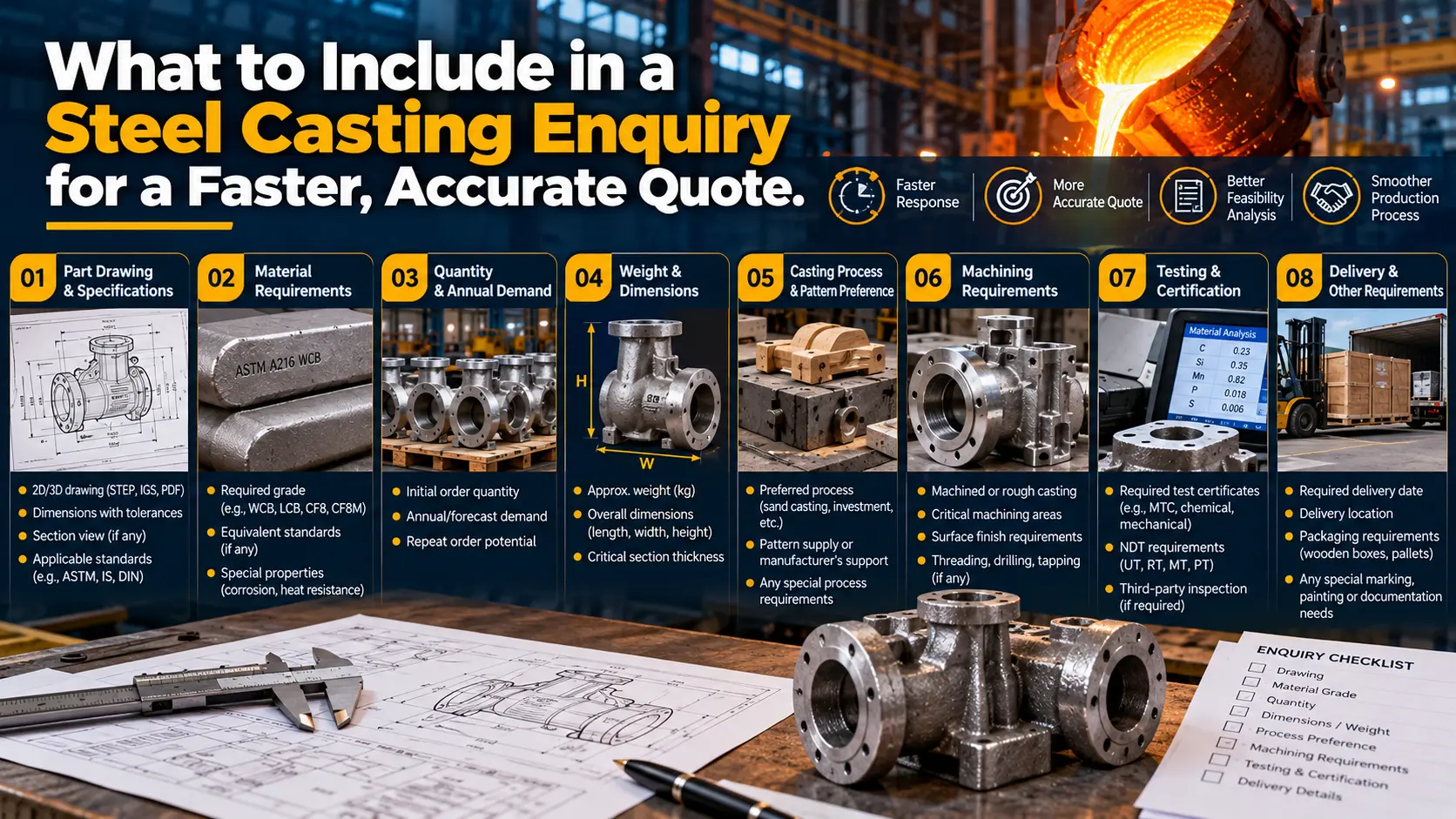
A steel casting enquiry gets a fast, accurate quote when it carries ten details: a current drawing, the exact material grade, quantity, part weight, machining scope, heat treatment, testing and certificates, surface finish and packaging, delivery terms, and tooling status. Leave one out and the foundry has two options. Guess, or write back with questions. Both cost you days.
Picture the estimator's morning. An enquiry arrives: a PDF with no revision letter, a line saying "carbon steel," and a quantity of "some." Nobody can price that. So the estimator pads the number to cover the unknowns, or sends back a list of questions and moves on to the enquiries that arrived complete.
A quote comes out fast when the estimator can work out melt weight, pattern cost, machining, heat treatment and testing from what you sent. This guide covers what to send and why each item moves the price.
What to Include in a Steel Casting Enquiry
A complete steel casting enquiry includes a drawing with the latest revision, the material grade and standard, order quantity, finished part weight, machining scope, heat treatment, inspection and certificate requirements, surface finish, delivery destination with Incoterms, and the status of existing patterns. Send these together in one email so the foundry can quote without follow-ups.
| Detail | What to send | Why it affects the quote |
|---|---|---|
| 1. Drawing | 2D PDF with revision, plus 3D STEP file | Shape and wall thickness decide pattern design and yield |
| 2. Material | Standard and grade, such as ASTM A216 WCB | Alloy cost and melting practice |
| 3. Quantity | First order and annual forecast | Tooling type and unit price |
| 4. Weight | Finished part weight | Metal cost, the biggest single input |
| 5. Machining | Raw, rough machined or fully machined | Allowances and machining cost |
| 6. Heat treatment | Process and target properties | Furnace time and test bars |
| 7. Testing | NDT methods, acceptance level, certificates | Inspection labour and schedule |
| 8. Finish and packaging | Blasting, coating, special packing | Labour and materials |
| 9. Delivery | Date, destination, Incoterm | Freight and scheduling |
| 10. Tooling | Existing patterns, part application | Pattern cost and design feedback |
The 10 Details of a Good Steel Casting Enquiry
1. Drawing and 3D model
Send both. The 2D PDF carries tolerances, notes and callouts. The 3D file (STEP is the safest format) lets the foundry judge wall thickness and where the metal will freeze last, which is exactly where shrinkage defects start.
Put the revision letter and date on the drawing, and repeat it in the email. A quote built on Rev B is worthless when your team has moved to Rev D.
Then mark what matters. Flag the functional dimensions (bearing seats, sealing faces, mounting holes) and say which are as-cast and which are machined. Name the casting tolerance grade as well. ISO 8062 is the usual reference for casting tolerances, and GD&T callouts should follow ASME Y14.5. Skip this and the foundry applies its own default, and you'll find out at inspection.
One opinion, earned the hard way by a lot of buyers: don't put tight tolerances on everything. If every dimension reads ±0.1 mm, the foundry prices every dimension that way.
2. Material grade and standard
"Carbon steel" isn't a grade. Neither is "stainless." Give the standard and the grade together:
- ASTM A216 WCB: carbon steel for general and pressure-containing parts such as valve bodies and flanges
- ASTM A351 CF8M: cast stainless, the cast counterpart of 316
- ASTM A743 CA6NM: 13Cr-4Ni martensitic stainless, common in pump and turbine parts
- ASTM A148 105-85: high-strength steel for structural castings
If you need specific mechanical properties (yield, tensile, impact energy at a stated temperature), list them. And say whether equivalents are acceptable. If a DIN, EN or GB grade works for you, writing that down widens the field of foundries that can quote, and a foundry already melting a close grade can often quote lower and ship sooner.
3. Quantity
Give two numbers: the first order and the annual forecast. Five prototypes and 2,000 pieces a year are different jobs. The second justifies a durable pattern and a repeatable molding setup. The first might not. Give only the first order and the foundry prices tooling as a one-off, so your unit price looks worse than it should.
"Some" isn't a quantity. If you can't commit, ask for price breaks at specific volumes, say 10, 100 and 500 pieces.
4. Weight
Send the finished casting weight from your CAD model, not an estimate. Steel is priced on metal weight, so this is the largest single input, and a rough figure is how quotes and final invoices end up apart. The foundry adds its own allowance for gating and risers, so you don't need to.
5. Machining scope
Is this a raw casting, rough machined, or fully machined and ready to assemble? Say so in the first paragraph of the email.
This is where quotes diverge most. One foundry prices a raw casting, another prices a finished part, and you end up comparing two numbers that don't describe the same product. Ask every foundry to quote the same scope. List the datums, bores, threads and faces to be machined, and if you're machining in-house, tell them how much stock you want left.
6. Heat treatment
Name the process: normalizing, normalize and temper, quench and temper, solution anneal, or stress relief. Add the target hardness or mechanical properties. And say whether the test bars must go through the same heat-treatment cycle as the casting. Each of these adds furnace time and testing, and the foundry can't price what it doesn't know about.
7. Testing, certificates and inspection
Visual and dimensional checks are the baseline. Anything beyond that, name it: UT, MT, PT, RT or PMI. Name the acceptance standard and level too, not just the method. "RT" on its own doesn't tell the foundry how clean the casting has to be.
For paperwork, ask for what you'll actually use. A material test certificate (EN 10204 3.1 is a common request) with chemical composition and mechanical results covers most jobs. Add heat treatment, NDT or dimensional reports only if your customer needs them. If a third-party inspector is involved (SGS, TÜV, Bureau Veritas, Lloyd's Register or DNV), name the agency, because their attendance affects cost and schedule.
Here's the part buyers resist: don't specify 100% radiography "to be safe." Stricter acceptance criteria and non-standard tests raise the price, and a pressure-retaining valve body and a counterweight don't need the same testing.Match the inspection to the duty of the part. More on this in our guide to casting inspection methods.
8. Surface finish and packaging
As-cast, shot blasted, ground, painted or coated? Name the paint system or galvanizing spec, and give Ra values for any critical surface. For packaging, say now if you need export wooden cases, a rust-preventive coating, or limits on pallet size and weight.
9. Delivery date, destination and Incoterms
Give the need-by date and say whether it's hard (a plant shutdown) or a target. Tight dates can mean expediting, which adds cost. Say whether partial shipments are fine. Then add the destination port or address and your Incoterm: EXW, FOB, CIF, DAP or DDP. Name none and the foundry picks one, and its price may not line up with the others you're comparing.
10. Tooling status and application
Do patterns and core boxes already exist? Tell the foundry their type, condition and where they're stored. A usable pattern can cut your cost. If no tooling exists, ask for pattern cost as a separate line so you can see it.
Then say what the part does. "Slurry pump casing, mining duty" gives the estimator context. A good one will flag a thin section, a sharp inside corner or a grade that won't last, and that feedback is cheaper at quote stage than at first-article inspection.
Steel Casting Enquiry Template (Copy, Fill, Send)
Subject: Enquiry: [Part name], [Drawing no.] Rev [X], [Quantity]
- Drawing and model: attached (PDF and STEP), Rev [X], dated [date]
- Material: [Standard and grade]. Equivalents acceptable: [Yes/No, which]
- Quantity: First order [X] pcs. Annual forecast [X] pcs
- Finished part weight: [X] kg
- Scope: [Raw casting / Rough machined / Fully machined]
- Heat treatment: [Process], target [hardness or properties]
- Testing: [Methods and acceptance standard]. Certificates: [Type]. Third-party inspection: [Agency or None]
- Surface finish: [Spec]. Packaging: [Requirements]
- Delivery: Need by [date]. Destination [port/address]. Incoterm [EXW/FOB/CIF/DAP/DDP]
- Tooling: [Existing patterns: Yes/No, condition]. Application: [What the part does]
- Contact: [Name, phone, email]
Common Steel Casting Enquiry Mistakes
- Sending a photo or screenshot instead of a drawing.
- Writing "carbon steel" or "SS" instead of a standard and grade.
- Quoting off a drawing revision that's no longer current.
- Giving different scopes to different foundries, then comparing the prices.
- Leaving out a contact name and phone number, so nobody can call to clear a doubt in five minutes.
Steel Casting Enquiry FAQs
What information is needed for a steel casting quote?
At minimum: a drawing with revision, the material standard and grade, quantity, and part weight. To get a firm price quickly, add machining scope, heat treatment, testing and certificate requirements, delivery terms and tooling status. The template above covers all of it.
What's the difference between a casting enquiry and an RFQ?
In practice, nothing. "Enquiry" and "RFQ" (request for quotation) both mean you're asking a foundry for a price. A formal RFQ sometimes carries commercial terms such as payment and warranty, but the technical information a foundry needs is the same.
Can I get a steel casting quote without a drawing?
You can get a rough, budgetary figure from a sample or a sketch with dimensions, weight and grade. You can't get a firm price. Foundries need the geometry and tolerances to size the pattern, the feeding system and the machining.
How long does a foundry take to quote a steel casting?
It varies by foundry and by part. A new, complex casting may need a solidification review before anyone commits to a price. A complete enquiry removes the back-and-forth, which is usually where the days go. Ask for the foundry's typical turnaround when you send it.
Should I send my enquiry to more than one foundry?
Yes, two to four is sensible. Send each one the identical package and the same scope, so the prices describe the same part and you can compare them fairly.
Send a Complete Enquiry, Get a Real Quote
Every item above is something the estimator would otherwise have to ask you for. Fill in the template, attach the drawing and the 3D file, and send it in one email.
Ready to get a price? Send your drawing and details to our team and we'll review it against this checklist. You can also read about our steel casting capabilities before you send.
Ready to Transform Your Manufacturing?
Discover how our advanced steel casting technology can revolutionize your manufacturing process.
Contact Us Today