What a Spectro Report Tells You About Your Steel Casting Grade
Learn how to read a spectro report for steel castings: what each element means, how to check it against your grade limits, and what the report can't tell you.
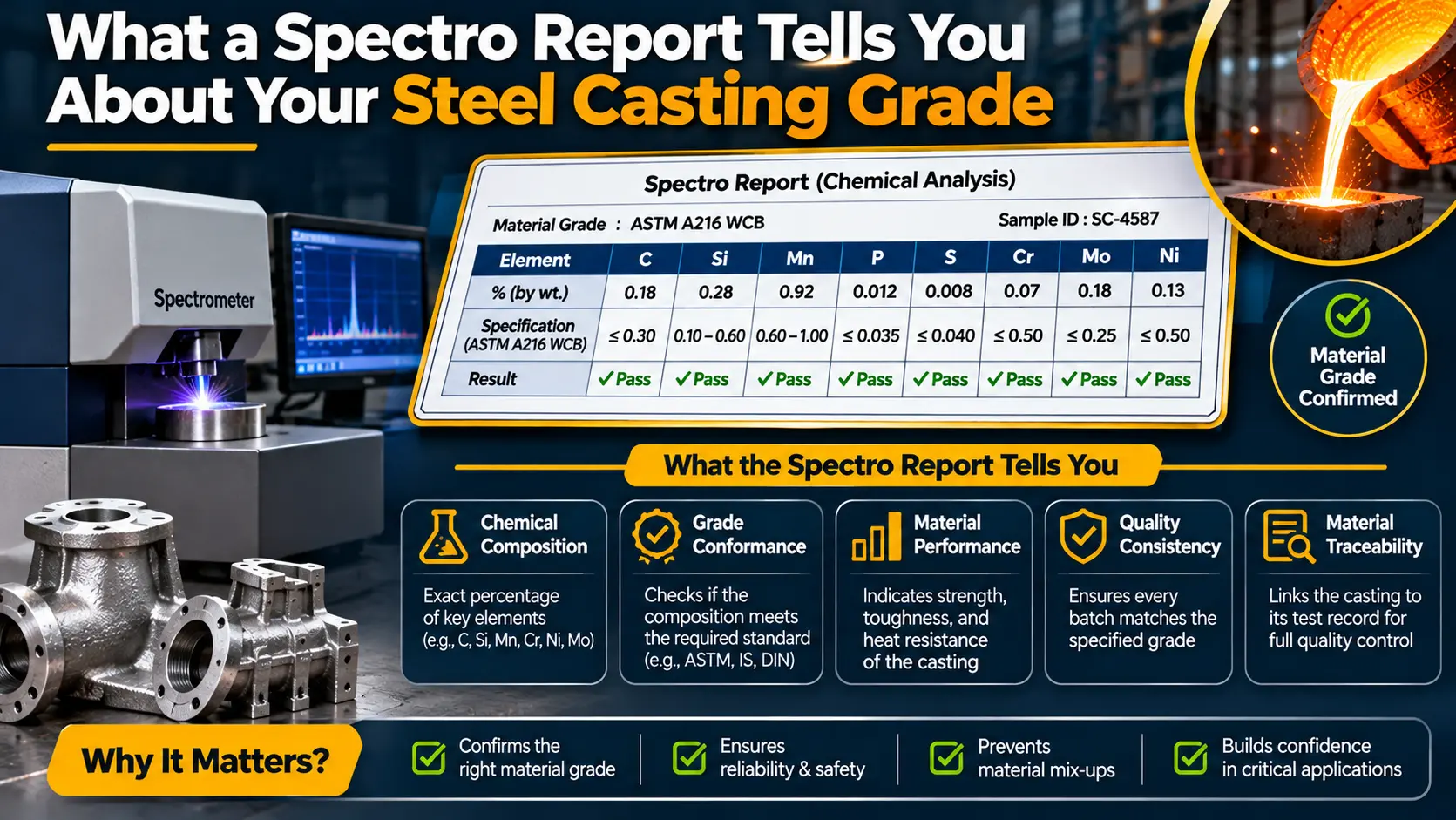
A spectro report is the lab record of your steel casting's chemical composition. It lists the percentage of each element (carbon, manganese, silicon, phosphorus, sulphur, plus any alloying and residual elements) so you can check the heat against the limits for your grade. It tells you what the steel is made of. It doesn't tell you how the casting will perform.
Say you ordered ASTM A216 WCB valve bodies, and the foundry ships them with a one-page spectro report. It's a block of numbers. Which ones do you check, in what order, and what do you do when one is off? That's what this guide covers.
What Is a Spectro Report in Steel Casting?
A spectro report is a chemical analysis certificate produced by an optical emission spectrometer (OES). A spark vaporises a tiny area of a polished steel sample, and the light it gives off reveals how much of each element is present. The report lists those percentages against your grade's minimum and maximum limits.
How to Read a Spectro Report in Six Steps
- Tie the report to your castings. Look for the heat or cast number, part number, PO number and date. If you can't connect the report to the pieces on your dock, it's decoration.
- Check the grade it was tested against. The report should name the standard and grade, such as ASTM A216 WCB. "Carbon steel" isn't enough, and it's worth confirming the edition of the standard too, because limits have moved between editions.
- Compare every element to its limit. Values are in weight percent. Some elements have a minimum and a maximum. Others have a maximum only.
- Read carbon first. It drives strength, hardness and weldability, and it's the element most often at the edge of its limit.
- Then phosphorus and sulphur. Both are impurities, so you want them low. Both are max-only.
- Finish with the residual elements and the sample type. Copper, nickel, chromium, molybdenum and vanadium creep in with scrap. And find out whether the sample came from the melt or from the casting itself (more on that below).
What goes wrong at each step is usually the same thing: the report exists but doesn't prove anything. A missing heat number, a grade that isn't named, a table that says "OK" instead of giving values. Send those back.
What Each Element Is Telling You
Here's the WCB case, since it's the grade most buyers meet first. The limits below are maximums.
| Element | What it does in cast steel | WCB limit (wt %) | If it runs high |
|---|---|---|---|
| Carbon (C) | Raises strength and hardness | 0.30 | Lower ductility and weldability, higher cracking risk |
| Manganese (Mn) | Adds strength, ties up sulphur | 1.00 | Higher hardness, harder to weld |
| Silicon (Si) | Deoxidises the melt, adds strength | 0.60 | Lower toughness |
| Phosphorus (P) | Impurity | 0.035 (some editions 0.040) | Brittleness, especially at low temperature |
| Sulphur (S) | Impurity | 0.035 (some editions 0.045) | Weak grain boundaries, hot cracking, lower ductility |
| Copper, nickel, chromium, molybdenum, vanadium | Residuals from scrap | 0.30, 0.50, 0.50, 0.20, 0.03 | Shifts hardenability and weldability |
Sources disagree on the phosphorus and sulphur limits for WCB (0.035 in some, 0.040 and 0.045 in others). That's the edition problem in action. Read the limits in the edition your purchase order cites, not the one on a datasheet.
Sulphur deserves a second look. High sulphur makes the casting prone to the ragged cracking we describe under hot tears, so a "clean" report on sulphur is worth more than it looks.
A Worked Example (Illustrative Numbers)
These figures are made up to show the method, not taken from a real heat.
| Element | Reported (wt %) | WCB limit (max) | Result |
|---|---|---|---|
| C | 0.26 | 0.30 | Pass |
| Mn | 0.78 | 1.00 | Pass |
| Si | 0.38 | 0.60 | Pass |
| P | 0.022 | 0.035 | Pass |
| S | 0.018 | 0.035 | Pass |
| Cu | 0.14 | 0.30 | Pass |
| Ni | 0.11 | 0.50 | Pass |
| Cr | 0.09 | 0.50 | Pass |
| Mo | 0.02 | 0.20 | Pass |
| V | 0.005 | 0.03 | Pass |
The residuals add up to 0.365%, well under the 1.00% total the standard allows for them. This heat passes.
Now change one number. Suppose carbon had come back at 0.33. That's over the limit, and the report is your evidence. Before you reject, read the footnotes in the standard, because some carbon steel grades allow manganese to run above the table limit when carbon is low. If the footnote doesn't rescue the heat, ask the foundry for a written explanation and corrective action, plus a retest on the casting itself.
What a Spectro Report Can't Tell You
A passing report proves the steel was the right recipe. It doesn't prove the casting is good. Three gaps matter:
- Mechanical properties. WCB should reach 485–655 MPa tensile, 250 MPa minimum yield, 22% minimum elongation and 35% minimum reduction of area. Those come from a tensile test, not from chemistry. Right chemistry with the wrong heat treatment still fails.
- Heat treatment. The permitted routes for WCB include normalising, annealing, or hardening plus tempering. Nothing on a spectro report shows which was done, or whether it was done at all.
- Soundness. A casting with perfect chemistry can still have gas porosity or shrinkage cavities inside. That's a job for NDT, covered in our guide to casting inspection methods.
So ask for the spectro report alongside the mechanical test and heat treatment records, not instead of them.
Spectro vs PMI vs XRF: Which Test Is Behind the Report?
Not every "chemistry check" is a spectro analysis, and the difference matters for one element in particular.
Spark OES measures carbon. XRF analysers can't, because carbon's atomic number is too low for the method to detect. A handheld XRF gun is fast (seconds, minimal prep) and good for sorting alloys and checking that the right material arrived. It can't tell 304H from 304L, since the difference between them is carbon.
So here's the rule. If your specification has a carbon limit, and for carbon steel it always does, a report based on XRF alone isn't enough. Ask which method produced the numbers. For carbon and low-alloy steel, ASTM E415 is the common spark OES test method, and a good report names it.
Melt Analysis vs Casting Analysis
Foundries test twice. Before pouring, a furnace sample goes to the spectrometer, and the result tells the melter what to add to hit the target chemistry. Many foundries check several times a day. After pouring, a final sample is taken, and that result usually forms the basis of the certificate you receive.
That means your spectro report normally describes the heat, not the finished casting. Chemistry can vary a little across a casting because of segregation, which is why standards allow a tolerance on product analysis. If the part is critical, specify a product analysis on the casting itself and agree the sampling location in advance.
Red Flags on a Spectro Report
- No heat number, so there's no traceability.
- The standard or grade isn't named.
- Pass/fail marks with no actual values.
- Residual elements missing when your specification limits them.
- Identical values to the last decimal across different heats.
Any one of these is a reason to ask questions before the castings go into service.
What to Ask Your Foundry
Put chemistry in the enquiry. State the standard, grade and edition, and say you want a spectro report for every heat, showing actual values, with the method named. If a part is critical, add a product analysis on the casting. Our steel casting enquiry checklist covers the rest of what to send, including testing and certificates.
Spectro Report FAQs
What does a spectro report show?
It shows the chemical composition of a steel sample as weight percent of each element, measured by an optical emission spectrometer. It's compared with the minimum and maximum limits for the grade to confirm the steel is the right material.
What's the difference between a spectro report and a mill test certificate?
A spectro report covers chemistry only. A material test certificate (EN 10204 3.1 is a common type) bundles chemistry with mechanical test results and often heat treatment details. Ask for both if your specification requires mechanical properties.
Can a handheld XRF analyser replace spectro analysis?
For sorting and checking that the right alloy arrived, yes. For anything with a carbon limit, no. XRF can't measure carbon, so spark OES is needed.
Does matching chemistry mean the casting will pass its mechanical tests?
No. Chemistry sets the potential. Heat treatment and soundness decide whether the casting delivers the tensile strength, yield and elongation your grade requires.
How often should a foundry run a spectro analysis?
Foundries typically check melt chemistry before every pour and several times a day. For your order, ask for a report per heat, and a product analysis on the casting when the application is critical.
Need a Spectro Report With Your Steel Castings?
Tell us the standard, grade and any chemistry limits you work to. Send your requirements to our team and we'll confirm what we can supply, including a spectro report for each heat.
Ready to Transform Your Manufacturing?
Discover how our advanced steel casting technology can revolutionize your manufacturing process.
Contact Us Today